What Is B2B Order Automation
and Why Does It Matter?
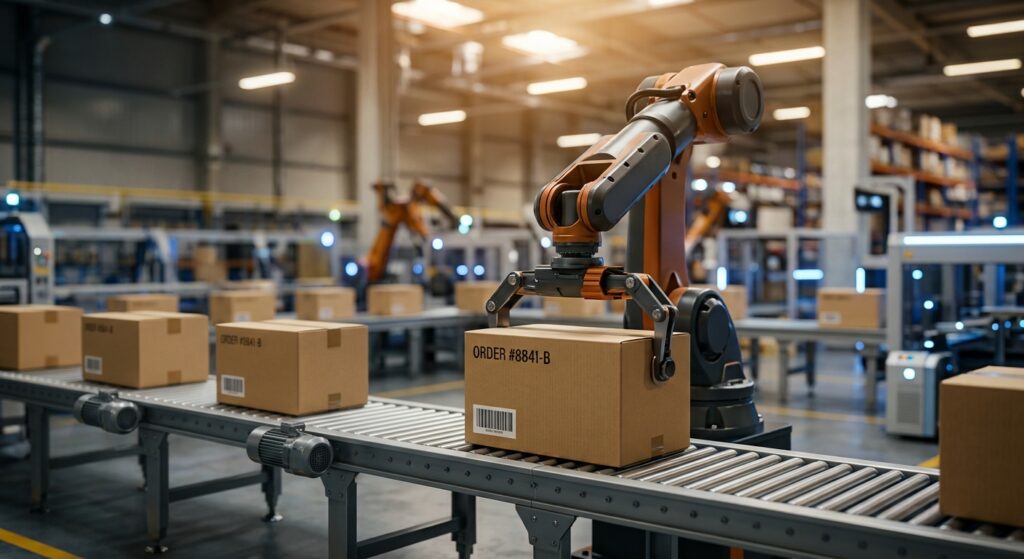
B2B order automation replaces manual purchase order entry with software that reads customer orders and creates matching sales orders in your system automatically. Instead of staff spending 5-10 minutes keying each PO from emails or PDFs, automation processes orders in 30 seconds to under a minute with near-zero errors.
For B2B manufacturers, distributors, and wholesalers, this delivers 80-90% reduction in per-order costs, error rates dropping from 5-8% to under 1%, and order-to-fulfillment cycle times cut by 40-60%.
What It Actually Does
B2B order automation refers to technologies that enable orders between businesses to be handled without manual intervention — from receiving the purchase order through to ERP integration and customer confirmation.
The software reads each incoming document (PDF, email, spreadsheet, EDI transmission), identifies the customer, matches every line item to your catalog, validates pricing and availability, and creates the order in your ERP or order management system.
AI-powered systems process purchase orders in six steps: ingest the document, extract data using OCR and machine learning, map products to your SKUs, validate against your catalog, flag exceptions for human review, and create the validated order. Manual purchase orders take 8 to 12 hours of total handling time. Automation brings that to 15 to 30 minutes — a 96% reduction.
Why It Matters
Cost Reduction
Manual purchase order processing costs $30 to $60 per order. Automated processing costs $5 to $10 per order — an 80-90% reduction. For a distributor processing 200 orders per day, automation would save approximately $400,000 to $600,000 per year in combined labor and error costs.
Error Reduction
Error rates drop from 5-8% with manual entry to under 1% with automated processing. Companies implementing AI order management report error reductions of up to 90%. On 1,000 monthly orders, that means 50 to 70 disputes avoided.
Faster Order-to-Cash
Automation shortens the average time between order and invoice, improving cash flow. Automated order processing reduces order-to-fulfillment cycle times by 40-60%. For a B2B distributor with €10M in revenue, shaving 5 days off DSO frees up approximately €140,000 in working capital.
Scalability
Automation removes the direct relationship between order volume and headcount. A $50 million distributor typically realizes labor-efficiency gains of $75,000-$180,000 per year through process automation.
Where Orders Come From
EDI (Electronic Data Interchange) — The most structured format and highest-volume channel. Cost per EDI transaction is under $1 compared to $30+ for manual processing. Start automation here first.
Email and PDF purchase orders — The most common manual channel. AI-powered extraction reads PDFs and email attachments, converts them to structured orders, and syncs to your ERP.
Spreadsheets, web portals, phone, and fax — Automation platforms handle these with varying levels of automation.
Punchout catalogs — Enterprise buyers access your eCommerce storefront from within their eProcurement system (SAP Ariba, Coupa, Oracle). When they complete shopping, the cart transfers back to their system as a requisition, which becomes a purchase order that flows directly into your order automation pipeline. Punchout removes friction for enterprise buyers and ensures all purchases comply with their approval workflows. It’s not mandatory for all suppliers, but matters when targeting large enterprises that expect this capability.
Implementation Roadmap
Phase 1: Assess (Week 1-2) — Document order volume by channel, time spent, error rates, and customer preferences.
Phase 2: Automate EDI First (Weeks 3-6) — Start with EDI because it’s the most structured and highest-volume channel.
Phase 3: Add Email, PDF and Punchout (Weeks 7-12) — Bring in email orders, PDFs, and CSV exports, and punchout connections for enterprise customers.
Phase 4: Run in Parallel and Optimize — Start with automation running alongside manual entry for 2-4 weeks, compare outputs, then switch fully once confidence is high.
Critical prerequisites: Ensure customer data is accurate, product codes are standardized, pricing is up-to-date, and catalog data is complete. Poor master data is the leading cause of automation failures.
Common Challenges
Exception handling
Not every order can be fully automated. Configure your system to flag exceptions for human review while processing standard orders automatically. Most systems achieve 80-90% touchless order rates.
Customer adoption
Some customers resist changing ordering habits. Start with your top 50 customers and send standardized order email templates to make it easier for them to order the way you prefer.
Integration complexity
Choose automation platforms with prebuilt connectors for your ERP (SAP, Oracle, Microsoft Dynamics, NetSuite).
Change management
Position automation as eliminating tedious data entry, freeing staff for higher-value work.
ROI Expectations
B2B order automation delivers 80-90% per-order cost reduction within 12 months. Most distribution businesses see positive ROI within six months, with payback periods of 3-12 months.
A small distributor processing 75 orders per day could redeploy 2 FTEs ($100K saved), with error reduction saving another $25K-$50K, against platform costs of $6K-$14K per year.
When It Makes Sense
Order automation is worth pursuing if:
- You process 50+ orders per day across multiple channels
- Your team spends significant time on manual order entry
- Error rates exceed 2-3%
- You struggle to scale during peak periods
- You have customers sending orders via email, PDF, or EDI
Manufacturers and distributors above 200 daily orders typically see payback periods of 8-14 months.
FAQ
What’s the difference between order automation and EDI?
EDI is one specific technology for transmitting standardized purchase orders. Order automation is broader — it includes EDI but also handles email, PDF, spreadsheet, and portal orders using AI and API integrations.
How long does implementation take?
Most implementations take 8-12 weeks for full deployment. EDI automation can be live in 3-4 weeks.
What percentage of orders can be automated?
Best-in-class B2B companies achieve 80-90% touchless order rates. The remaining 10-20% require human review due to exceptions.
Does it work with my ERP?
Leading platforms support integration with major ERP systems including SAP, Oracle, Microsoft Dynamics, NetSuite, and Infor.
RECENT POSTS
What Is B2B Order Automation
How to Make It Easier for Large Companies to Buy From You
Why B2B Buyers Choose Your Competitors
Is Your Procurement Process Stuck in the Past?
10 Common Punchout Catalog Problems (and How to Fix Them)
What is cXML? Explained In 4 Quick Points
Want to learn more about our solution? Reach out to our sales team to request a demo: