
How to Make It Easier for Large Companies to Buy From You
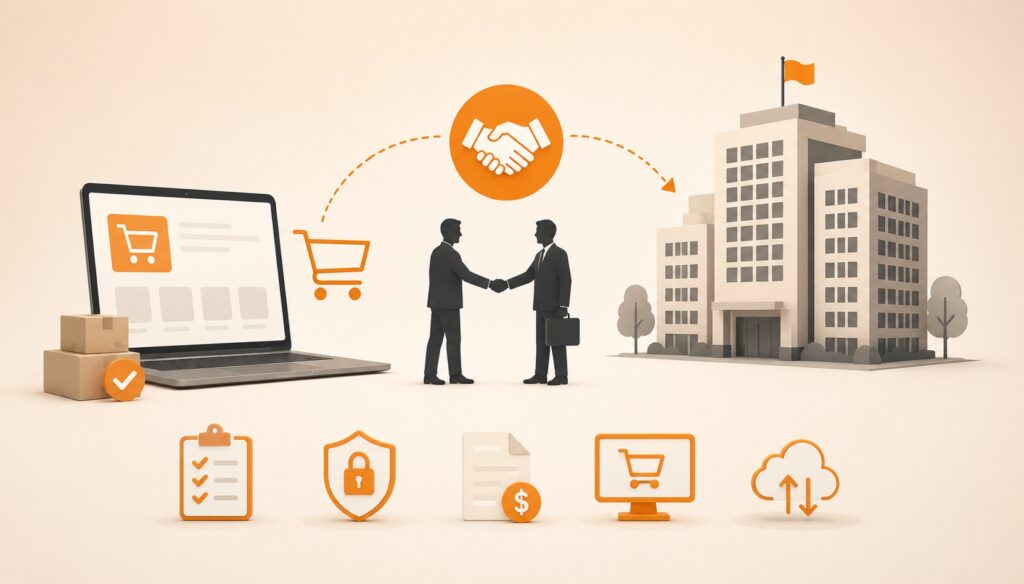
Selling to medium and large enterprises requires more than having a great product. Enterprise buyers operate within structured procurement systems, compliance frameworks, and multi-stakeholder approval processes that differ fundamentally from how smaller businesses purchase. If your operations, documentation, and technology cannot align with their requirements, you will lose deals regardless of product quality.
This article explains what enterprise buyers expect from suppliers and the concrete steps you can take to reduce friction and win more business.
Why Enterprise Buying Is Different
Enterprise procurement exists to manage risk, ensure compliance, and maintain operational continuity at scale. Large organizations cannot afford supplier failures, security breaches, or delivery disruptions that could impact thousands of employees or millions in revenue. As a result, their buying processes are deliberately structured, involving multiple stakeholders, formal documentation, and extended evaluation periods.
The average B2B buying group now includes 13 internal stakeholders and 9 external participants on complex purchases. Two-thirds of B2B buyers prefer engaging vendor salespeople only in the later stages of the journey, having completed 60% of their evaluation through independent research. This means your company must be easy to evaluate, easy to onboard, and easy to purchase from before a salesperson ever gets involved.
Key Stages Where Suppliers Get Eliminated
Supplier qualification is where many suppliers are eliminated for lacking required certifications, security documentation, or integration capabilities. Enterprise buyers evaluate vendors through three primary lenses: stability and reliability, security and compliance, and integration and disruption risk.
Formal evaluation typically involves a Request for Proposal (RFP) or Request for Quotation (RFQ), where vendors respond to structured questions covering product capabilities, implementation methodology, pricing, and references. The entire process can take weeks to months depending on deal size and organizational complexity.
Typical stakeholders include end users, technical evaluators, procurement specialists, finance teams, legal and compliance officers, and executive sponsors. Understanding who holds influence at each stage helps you provide the right information to the right people at the right time.
Supplier Onboarding: Your First Impression Matters
Supplier onboarding is the structured process through which enterprise buyers evaluate, register, and integrate new vendors into their procurement workflow. Getting this right reduces time-to-revenue and demonstrates operational maturity. Many suppliers lose deals not because their product is inferior, but because they cannot complete onboarding efficiently.
What Enterprise Buyers Require During Onboarding
Large organizations typically request the following documentation during supplier onboarding:
Legal and identity verification includes registered business name, address, company registration number, and tax identification documents such as W-9 (US) or W-8 (foreign) forms.
Financial documentation encompasses two years of financial statements, Dun & Bradstreet or credit scores, and bank account details independently validated through trusted channels. Payment terms are established at this stage, typically Net 30 for standard B2B transactions, though large enterprises may require Net 60 or Net 90.
Compliance screening involves sanctions list checks, watchlist screening, beneficial ownership disclosure, and adverse media searches. Fortune 500 and public sector buyers now require supplier diversity data as part of every RFP.
Insurance and certifications include liability coverage, quality certifications such as ISO 9001, and sector-specific licenses. Security documentation may include SOC 2 Type II reports, ISO 27001 certificates, penetration test summaries, and completed security questionnaires.
Common Onboarding Mistakes
Suppliers frequently delay or derail onboarding by providing incomplete or outdated documentation, failing to designate clear points of contact, not having bank account details independently verified, or lacking required certifications. Best practice is to prepare a supplier onboarding package in advance containing all standard documentation, organized and ready to transmit immediately upon request.
Best Practices for B2B Invoicing
Enterprise buyers expect invoices to include specific information to enable automated three-way matching between purchase orders, goods received notes, and invoices. Key requirements include:
- Purchase order number prominently displayed on the invoice
- Clear payment terms stated unambiguously with a specific due datecorpay
- Itemized line items matching the PO exactly, including quantities, unit prices, and totals
- Tax identification numbers and appropriate tax calculations
Electronic invoicing is increasingly expected, with many large organizations requiring invoices in specific formats compatible with their accounts payable automation systems.
Making Your Products Easy to Purchase
Enterprise buyers want to purchase through their existing procurement systems rather than navigating separate supplier websites or manual processes. Reducing friction in the purchasing experience directly impacts your win rate and order volume.
Customer-Specific Catalogs and Contract Pricing
Large organizations often negotiate custom pricing based on volume commitments, contract terms, or strategic partnerships. They expect to see only the products they are authorized to purchase, at the prices agreed in their contract.
Customer-specific catalogs allow you to show different products to different customers based on their contracts or buying groups, apply contract pricing automatically, hide irrelevant products, and sync prices in real time across channels. This capability is particularly important for distributors and wholesalers serving multiple enterprise accounts with different pricing agreements.
Electronic Ordering and Purchase Order Automation
Enterprise buyers increasingly expect electronic ordering capabilities that integrate directly with their procurement systems. This includes electronic purchase orders transmitted directly from the buyer’s ERP or eProcurement system, purchase order acknowledgements confirming receipt automatically, advanced shipping notices providing real-time visibility, and electronic invoicing enabling automated three-way matching.
These capabilities reduce manual data entry, minimize errors, and accelerate the entire order-to-cash cycle. For suppliers, electronic ordering means orders flow directly into your system without requiring sales team intervention.
Punchout Catalogs: When They Matter
Punchout is a procurement integration technology that allows enterprise buyers to access your eCommerce storefront directly from within their eProcurement system. When a buyer “punches out” from their procurement platform (such as SAP Ariba, Coupa, or Oracle), they are redirected to your website where they can browse products, view real-time pricing, and add items to a shopping cart.
When the buyer completes their shopping session, the cart contents are transferred back to their procurement system as a requisition, which then flows through their internal approval workflow before becoming a purchase order.
Punchout matters for suppliers targeting large enterprises because it removes friction by allowing buyers to shop within their familiar procurement environment, ensures compliance by routing all purchases through the buyer’s approval workflows, provides real-time pricing and availability, and automates order transmission. However, Punchout is not necessary for all suppliers. It makes sense when you are actively pursuing enterprise accounts that use eProcurement systems and expect this capability.
ERP Integration Capabilities
Major enterprise ERP systems include SAP, Oracle, Microsoft Dynamics, NetSuite, and Infor. Your eCommerce or order management platform should support integration with these systems to enable real-time inventory synchronization, automated order transmission, customer and product data synchronization, and financial data integration.
Leading B2B eCommerce platforms offer varying levels of ERP integration capability. Adobe Commerce provides unlimited custom integration possibilities. Shopware offers native SAP and Microsoft Dynamics connectivity. Shopify Plus provides prebuilt integrations with 10,000+ business systems including all major ERPs.
Security and Compliance: Non-Negotiable Requirements
Enterprise buyers will not proceed with suppliers who cannot meet their security and compliance requirements. These are not optional considerations but baseline expectations that must be addressed before procurement evaluation begins.
Security Requirements
Typical security expectations from enterprise buyers include:
- Single Sign-On (SSO) enabling users to authenticate through their corporate identity provider
- Role-based access control (RBAC) ensuring users can only access data appropriate to their role
- Audit logs tracking all user actions for compliance and security monitoring
- Encryption at rest and in transit protecting data from unauthorized access
- SOC 2 Type II reports demonstrating operational security controls (within the last 12 months)
- Penetration test summaries showing recent security testing (within the last 12 months)
- Security questionnaires such as SIG Lite responses addressing specific security controls
If any of these security capabilities are missing, most enterprise buyers will not move past the evaluation stage.
Common Mistakes Suppliers Make
Starting procurement conversations too late. Enterprise procurement processes should begin earlier than suppliers typically expect. Ask your champion who owns the vendor approval process and make introductions early in the evaluation cycle.
Failing to map the buying process. Enterprise deals involve multiple stakeholders and approval stages. Suppliers who do not understand the buyer’s internal approval process, timeline, and decision criteria lose momentum and miss critical requirements.
Not providing security documentation proactively. Security reviews are formal gates in enterprise procurement, not optional steps. Suppliers who wait to be asked for security documentation appear unprepared.
Inadequate stakeholder engagement. Enterprise deals require multi-threaded relationships across the buying organization. Engage three or more stakeholders within the first 30 days and track engagement across all parties.
Questions to Ask Yourself Before Pursuing Enterprise Customers
Before investing in enterprise sales, evaluate whether your organization is ready:
- Can your product scale to handle enterprise-level volume and uptime requirements?
- Do you have the security and compliance documentation that enterprise buyers require?
- Can you support extended payment terms such as Net 60 or Net 90 without impacting cash flow?
- Do you have integration capabilities with major ERP and eProcurement systems?
- Can you provide dedicated support and rapid response times for enterprise accounts?
- Do you understand the procurement process and have resources to navigate it effectively?
If you cannot answer yes to most of these questions, focus on building these capabilities before pursuing large enterprise accounts.
FAQ
How long does enterprise supplier onboarding typically take?
Supplier onboarding timelines vary by organization size and risk profile, but typical enterprise onboarding takes 2-6 weeks from initial documentation submission to system activation. High-risk suppliers or those in regulated industries may require 8-12 weeks for complete compliance verification.
Do I need Punchout capability to sell to enterprises?
Punchout is not mandatory for all enterprise sales but becomes important when targeting large organizations that use eProcurement systems such as SAP Ariba, Coupa, or Oracle. If your target customers expect to purchase through their procurement platforms, Punchout capability removes friction and ensures compliance.
What happens if I cannot meet enterprise compliance requirements?
If you cannot meet baseline security and compliance requirements, enterprise buyers will not proceed with procurement evaluation. These requirements are non-negotiable gates in the procurement process, not optional preferences. Focus on building required capabilities before pursuing enterprise accounts.
Conclusion
Making it easier for large companies to buy from you requires aligning your operations, documentation, and technology with enterprise procurement expectations. This includes preparing comprehensive onboarding documentation, supporting standard payment terms, offering customer-specific catalogs and pricing, enabling electronic ordering, and meeting security and compliance requirements.
Enterprise buyers evaluate vendors through lenses of stability, security, and integration fit. If your company cannot demonstrate operational maturity in these areas, you will lose deals regardless of product quality. Invest in the capabilities that reduce friction for enterprise buyers: prepare documentation in advance, integrate with major ERP and eProcurement systems, and understand the procurement process thoroughly.
RECENT POSTS
What Is B2B Order Automation
How to Make It Easier for Large Companies to Buy From You
Why B2B Buyers Choose Your Competitors
Is Your Procurement Process Stuck in the Past?
10 Common Punchout Catalog Problems (and How to Fix Them)
What is cXML? Explained In 4 Quick Points
Want to learn more about our solution? Reach out to our sales team to request a demo: